
Pharmaceutical research and service design
Background
In late 2024, Debbie was hired as a freelancer by a European UX agency working with a pharmaceutical client that we’ll call PharmaCo to keep them anonymous.
It was supposed to be a two-month project that ran late due to holiday delays and PharmaCo having trouble recruiting good participants. The project was completed in February 2025 with the final report delivered in March 2025.
What they had
- PharmaCo had a sense of the problems customers tended to have with returns and claims.
- “Returns” were when a vaccine season was over, and customers wanted to return unused doses for partial credit.
- “Claims” were when vaccines arrived damaged or were not kept at the right temperature during shipping, and would need to be returned or replaced.
- These were different tasks but had many of the same process steps.
- Before generative research began, PharmaCo had decided that a new portal would solve key problems.
- They also had an assumption that customers wanted to use their phones more for these problems.
What they wanted
- Generative research to understand customers’ tasks, experiences, and pain points during returns and claims processes.
- Problem space exploration with a target audience of doctors’ offices, pharmacies, hospitals, pharmaceutical wholesalers, and others.
- Concept testing around potential portal functionality.
- A stakeholder who was heavily involved in every moment of our work, cough cough.
What we did
Research Plan, Protocol, Script, Guide
The study required two sessions with each participant. First, a 90-minute moderated interview to discuss and map the current states of their returns and claims processes. A separate session was 60 minutes long, and tested the portal concept via a storyboard PharmaCo provided.
As Debbie would be working with the Americans and another Researcher worked with the French customers, both Researchers worked together on the planning and questions so that they would be the same in both languages.
Generative and evaluative sessions had separate discussion guides.
Recruiting, Scheduling, Communication
This was the main project blocker. PharmaCo was unable to find potential participants in most of the intended categories. Debbie was connected to only five participants in one category, Vaccine Coordinator roles at doctors’ offices around America. They managed anywhere from one to 20 office locations.
After a warm introduction, Debbie handled the communication and scheduling with each.
Session Execution
All ten sessions were conducted and recorded using Zoom. While discussing each task, Debbie shared her screen and live-mapped the process steps, details, collaborators, workarounds, tools, and more to get a complete picture of the customers’ journeys through their eyes.
During the concept testing sessions, participants were shown the storyboard, step by step, read a script about what would happen at each step, and were asked for feedback.
Analysis, Synthesis, and Report
Analysis and synthesis went relatively quickly with only five participants. Pain points were common across customers, and the problem statements were clear.
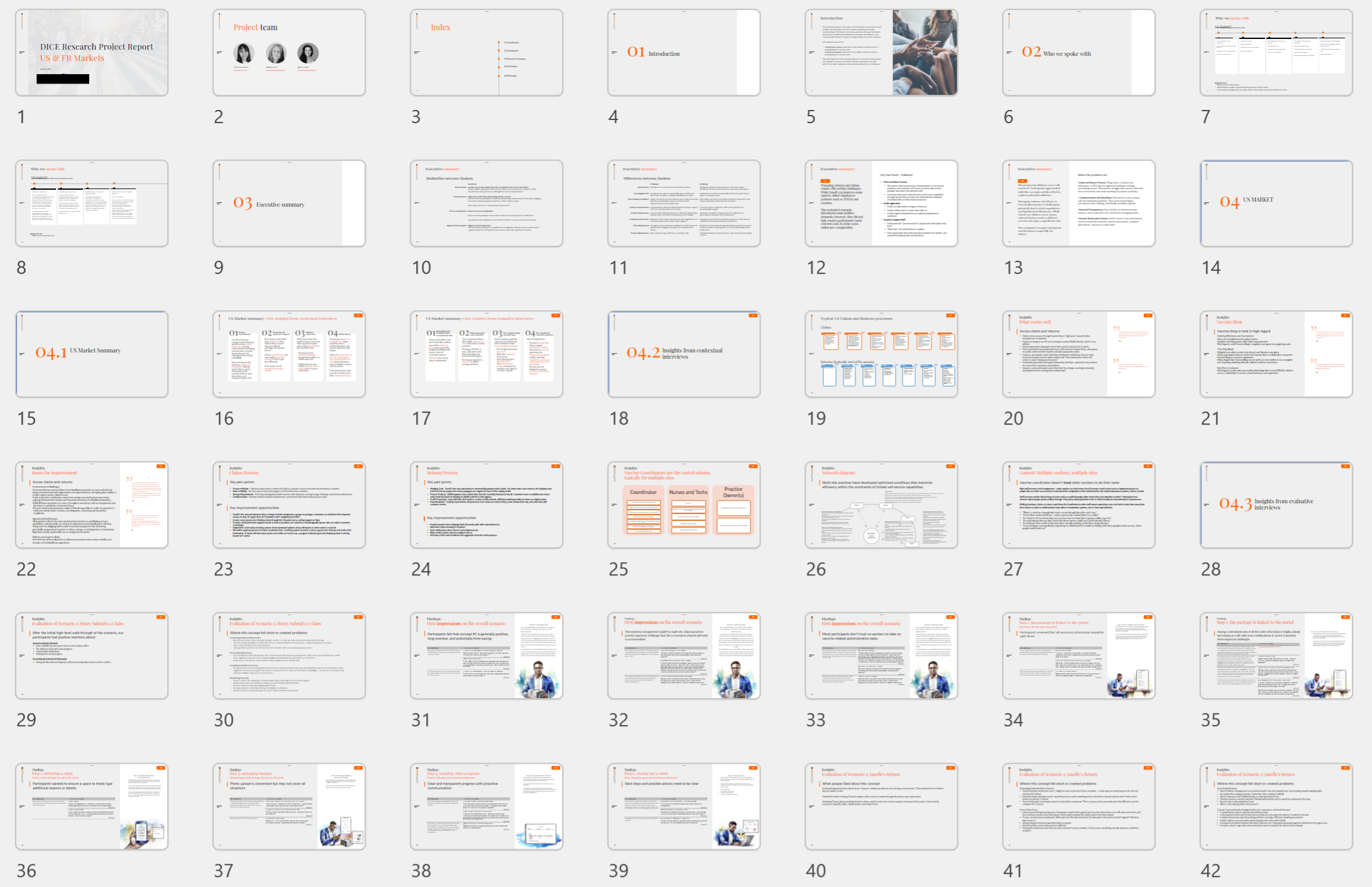
Following the agency’s slide deck template and the elements the client specifically wanted covered, the report detailed the current processes, what works and what doesn’t, and key areas of improvement.
Insights, Opportunities, Suggestions
Without giving away anything confidential, the current problems with returns and claims were plentiful. Customers experienced barriers, confusion, anger, distractions, ineptitude, and delays seemingly constantly.
The problems were way beyond what a portal might solve, bringing the solution into question… which the client was not completely prepared for. They had assumed that a great portal would solve the key problem, but they appeared to have assumed that the main problem was the “communications black hole”: people needed more updates about the status and progress of a return or claim. If that’s the real problem or JTBD, then the portal should solve that.
But that wasn’t true in this case.
Most of our participants didn’t want to use their phones more in this process, especially their personal phones. They wanted more separation between work and personal devices and messages. Therefore, solutions with QR codes and phone usage were generally not desirable.
Additionally, the portal mostly failed concept testing. It didn’t do what people needed or expected. And in some cases, the storyboard showed a new process that participants found nonsensical. You started the return or claim in the portal, you put in the details, you got a return authorization form, you printed this, and you scanned a QR code to continue the process from your phone. This made no sense since once you have an RA form, what is there to continue? Why get phones involved? It seemed like PharmaCo wanted to wedge phones and QR codes into this process, even if it didn’t make sense or work for customers.
Continue reading below for more of this story!
This became a when the client asked me how I would solve the problems.
Does the portal solve the problems?
The client was not thrilled with my report indicating that, while the portal could be nice, it doesn’t actually solve most of the problems. Key problems included:
- Couriers don’t deliver packages on time or when offices are open. Some packages are left outside in the elements, with vaccines going bad, especially in warmer months. Doctors’ offices post signs for couriers, but those instructions are never followed.
- PharmaCo no longer puts temperature gauges in boxes, leaving Vaccine Coordinators to hope that vaccines are good, which they are not happy about.
- Customer Support isn’t great. They seem poorly trained and unprepared for situations that happen often. Responses are slow, but vaccines are time-sensitive; patients will come in expecting to get these shots. Doctors need them in stock now.
- Credits are very slow to be issued and hard to use.
If systems continue operating as they do now, then a portal doesn’t really solve these problems. In a frustrated moment, the client asked how I would solve the problems. This was not part of the project scope, but the agency gave me permission to spend a few hours writing up the suggested solution.
The best solution is for a problem to never happen.
- What can PharmCo do to get the couriers to improve? PharmaCo is losing money on these problems. They’re probably a large client of these couriers. Can they work with them on improving temperature-sensitive deliveries so the waste never happens?
- Customers don’t want more emails or text messages notifying them of every step of a returns or claims process, especially since those are sometimes over a month long. Customers are already drowning in emails.
- Customers want temperature gauges back in boxes, and they want PharmaCo to pay for return shipping. Other pharmaceutical companies do both of these.
- Customers expected the return process to look more like Amazon: as soon as I ship the package, give me my credit. Amazon doesn’t make people wait through weeks of “you shipped it,” “our warehouse got it,” “someone is looking at your package,” “ok, you sent back the right thing,” “hey, we’re processing your return,” and, “ok, here’s your money.” Amazon gives you a usable credit the moment the tracking shows that the package was shipped. Amazon starts by trusting that you sent back the correct item; PharmaCo should trust its customers, who are professional businesses, to ship the damaged or unused items.
- A portal might have some nice features, but customers want the problem to never happen. And there is a lot going on here that requires service design efforts from PharmaCo, going beyond “a new portal.”
This is ultimately a service design project. The portal could be a part of the digital solution, but there are many non-digital issues here that need deep attention and change if PharmaCo wants to truly solve the problems at their root causes.