
Hosting company CRO and market expansion
Background
In February 2026, a European hosting company came to us with questions they couldn’t answer. They had started moving into the Italian market, but it wasn’t as successful as they expected. We’ll call them “HostingCo” to keep them anonymous.
What they had
- Analytics showing that many people abandon the website after step 2 of the checkout.
- Two ICPs, essentially based on business type.
What they wanted
- A better understanding of visitor’s behaviors related to shopping for hosting.
- An explanation for why visitors tend to abandon the checkout after the second step.
- Suggestions on how they need to change messaging, their website, etc. to improve conversion rates.
Project plan
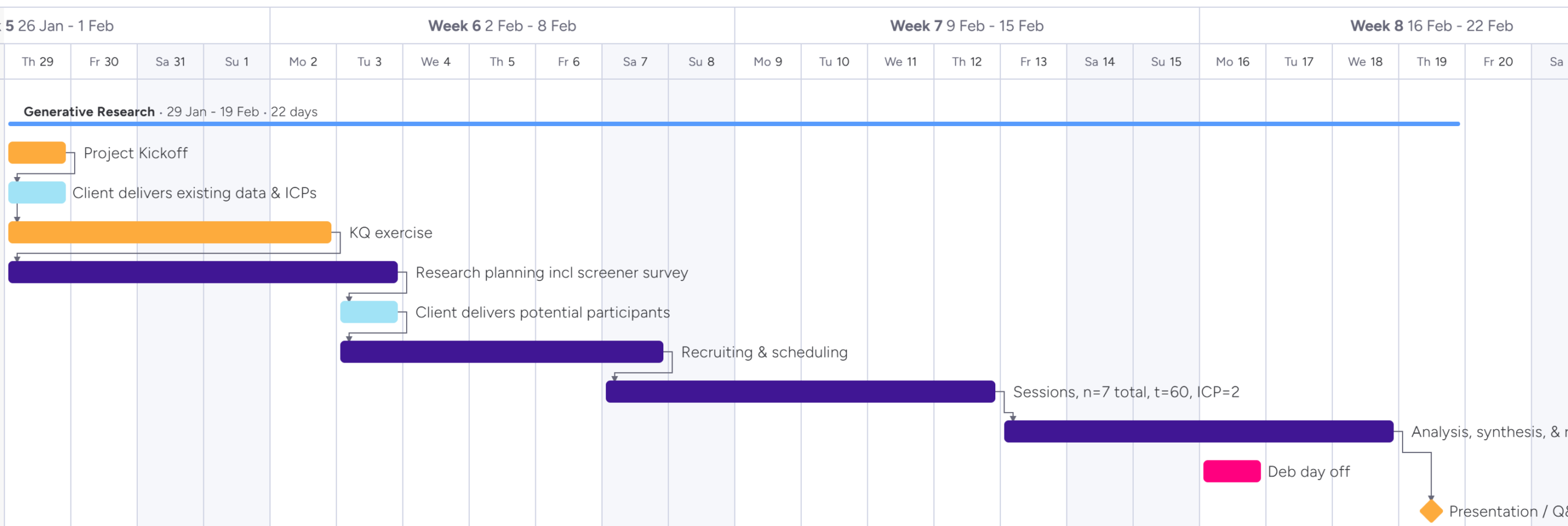
With a short time frame, we put together a project that would take around three weeks. This was our Gantt chart:
What we did
Research Plan, Protocol, Script, Guide
60-minute research sessions would take place fully in the Italian language since the target audience were all Italians. We brought in a Researcher born and raised in Italy.
The project had a very short deadline and recruiting would be difficult. We wanted to meet 8 of each ICP, but given the constraints, we planned for 5 of each.
Our research plan was influenced by the questions our stakeholders wanted answered, collected on a “Knowledge Quadrant” Miro board.
Recruiting, Scheduling, Communication
This was more difficult than expected. The client reached out personally to their customers, and sent them to our screener survey. We ran a paid LinkedIn ad to try to reach Italians fitting the ICPs. The Italian Researcher also sent the screener survey to some of their contacts.
We had fewer than 20 responses in total, including a few people who fell into our honeypot, claiming that they were a former customer or had heard of a fake company we made up. Everybody who qualified was invited, but some never scheduled.
To stay within the deadline, we met everybody we could, which was 7 in total.
Session Execution
All ten sessions were conducted and recorded using Zoom. Participants shared their screens, and were asked to show how they shop for and evaluate hosting companies. We wanted to learn all of the dimensions of the tasks and decisions.
Analysis, Synthesis, and Report
The Italian Researcher reviewed the transcripts and corrected them. They made some notes in a Miro board.
We worked with Claude Sonnet 4.5 to speed up the analysis and synthesis. We delivered a slide deck as a PDF.
Insights, Opportunities, Suggestions
Without giving away anything confidential, the key problems with the customer experience was that many people didn’t understand what they were getting for how much money. Hosting sites are notoriously confusing, and this one unfortunately followed that template.
Lower-knowledge visitors didn’t understand tech terms or what they needed. Higher-knowledge visitors didn’t see the more granular details they needed to trust that they were making the best purchase.
Visitors mostly made it into the shopping cart not because they intended to buy, but to use the cart as a calculator. They hoped this would clearly show the exact price they would pay for a particular package and length of time.
Bonus: We challenged their ICPs.
Despite only meeting seven people, we suggested that splitting them up by business type might not be as helpful or meaningful as segmenting customers by knowledge: low, medium, and high.
We also questioned how the website appears to be designed for the low-knowledge typology. Yet we learned that this is the group that is most likely to buy the cheapest package, need the most technical support, and then leave after their discounted first year is over. This is probably not the best sweet spot for long-term success and profitability.